Designing Staircases for Bushfire Risk and Coastal Conditions in Wollongong
January 29, 2026


Designing an external staircase means engineering for both bushfire exposure and harsh coastal conditions, not just aesthetics or access. A successful stair here must withstand ember attack, salt-laden air, high winds and heavy rain while remaining compliant, safe and durable long-term. Here at Coastal Stairs, we know that getting the design right from the outset is essential to meeting BAL requirements, managing marine exposure and satisfying inspection standards, while also protecting the long-term value of the property.
This guide is for homeowners, builders, architects and developers working with stair builders in Wollongong who need external stairs that perform reliably in coastal and bushfire-prone environments. Remember that poor material choices, incorrect fixings or non-compliant detailing can lead to accelerated corrosion, fire vulnerability, safety risks and costly rectification work.
This article explains how bushfire attack levels (BAL ratings) influence staircase design, how coastal exposure affects material and coating selection and how to balance fire resistance, corrosion protection and appearance. We’ll also cover compliant materials, fixings, protective systems and practical design details, so your external stairs don’t just pass inspection but continue performing safely for years in demanding conditions.
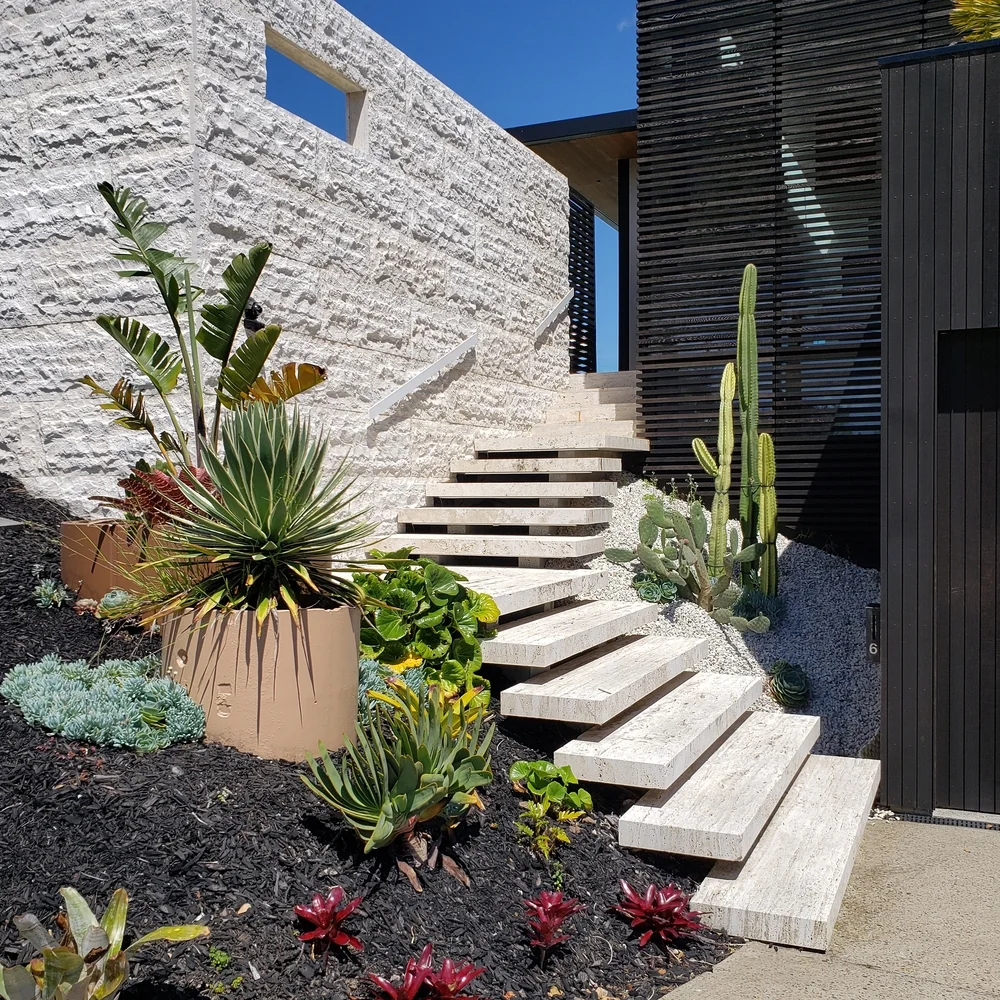
External staircases in bushfire-prone areas must be designed to withstand ember attack, radiant heat and direct flame exposure, particularly in regions influenced by the escarpment and surrounding bushland. Compliance is not limited to material selection alone; it also extends to detailing, fixings, gaps and junctions where embers can accumulate. When these factors are addressed early in the design phase, staircases can meet BAL requirements without becoming overly heavy or industrial in appearance. A well-considered approach ensures safety and compliance are embedded into the structure rather than added as afterthoughts.
Style does not need to be sacrificed to achieve bushfire resilience. By combining non-combustible or BAL-rated materials with clean lines, refined proportions and thoughtful finishes, staircases can remain visually aligned with the architecture of the home. Careful integration of handrails, balustrades and landings allows the stair to feel cohesive and intentional, rather than purely functional. When design and compliance work together, the result is an external staircase that performs under bushfire conditions while still enhancing the overall aesthetic of the property.
The challenge is achieving compliance without producing a stair that feels overly industrial or visually disconnected from a coastal home. Our approach focuses on materials that inherently meet BAL requirements while still allowing for refined detailing and architectural intent.
For higher BAL zones, non-combustible and bushfire-resistant materials form the foundation of the design. Commonly specified options include:
These materials are combined thoughtfully to balance fire performance, coastal durability and visual warmth.
Beyond materials, bushfire compliance is heavily influenced by how a staircase is detailed. Stair designs must minimise horizontal ledges, avoid debris-trapping cavities and ensure junctions are sealed or detailed to prevent ember accumulation. Addressing these risks at the design stage avoids costly modifications later.
We focus on clean transitions between treads, stringers and landings, ensuring joints are tight and finishes are continuous. Open risers, where permitted, are carefully proportioned to reduce ember lodging, while solid risers are detailed to avoid hidden voids. Fixings are selected for fire resistance and corrosion performance, particularly in coastal exposure zones. These detailing decisions quietly improve bushfire resilience without altering the visual simplicity of the stair.
External staircases are exposed not only to bushfire risk but also to salt-laden air, strong winds and driving rain. Materials that perform well under fire conditions must also resist corrosion and long-term weathering. A staircase that meets BAL requirements but fails prematurely due to coastal exposure is not a successful outcome. This dual environment requires careful coordination between fire performance and marine durability.
We address this by specifying corrosion-resistant steel grades, appropriate galvanising systems and high-performance powder-coated or painted finishes. Concrete elements are detailed with proper drainage and protective sealers to reduce salt ingress and surface degradation. Timber, where permitted, is isolated from moisture traps and fixed in a way that allows for movement and ventilation. These strategies ensure the staircase performs safely under bushfire conditions while remaining robust in a coastal setting.
Bushfire-compliant staircases do not need to appear heavy, defensive or purely utilitarian. When materials and detailing are coordinated early, the stairs can remain a deliberate architectural feature rather than a regulatory afterthought. Proportion, colour selection and integration with surrounding materials play a major role in achieving this balance. A compliant stair should feel resolved within the broader design language of the home.
We often use restrained colour palettes, matte finishes and consistent material transitions to allow the staircase to sit comfortably alongside cladding, masonry or render. Glass or minimalist steel balustrades, where permitted, help maintain openness without compromising compliance. Lighting is also used to highlight form and improve safety without adding clutter. The result is a staircase that satisfies bushfire requirements while still enhancing the home’s overall appearance.
Different conditions accelerate corrosion, degrade finishes and place ongoing stress on fixings and joints if materials and detailing are not selected carefully. Coastal exposure can be just as demanding as bushfire risk when it comes to long-term performance. A staircase designed without considering these factors will often require frequent repairs or early replacement.
A durable coastal staircase relies on a combination of corrosion-resistant materials, protective finishes and detailing that sheds water and limits salt buildup. Attention must be given not only to visible components but also to hidden fixings, connections and interfaces where deterioration often begins. When durability is addressed at the design stage, maintenance requirements are reduced and the structure retains its appearance for longer. The result is an external staircase that remains safe, compliant and visually consistent with the home despite ongoing exposure to harsh coastal conditions.
The goal is not only to achieve a clean appearance on completion but also to ensure the structure remains safe, sound and visually intact for decades. Corrosion is the primary long-term threat, particularly where finishes or fixings are poorly selected or incorrectly installed. Addressing this risk early reduces maintenance demands and premature deterioration.
For steel staircases, hot-dip galvanising forms the foundation of corrosion protection. Galvanising after fabrication ensures welds, cut edges and concealed surfaces receive consistent coverage, rather than leaving vulnerable points exposed. Detailing before galvanising is critical, with drainage paths, vent holes and open sections designed to prevent trapped moisture. Even the best coating systems will fail if water or debris is allowed to sit within joints or enclosed profiles.
While galvanising provides essential base protection, additional coating systems are often required to extend service life in aggressive coastal conditions. We commonly specify duplex systems that combine galvanising with high-build epoxy primers and durable polyurethane or polysiloxane topcoats. This approach improves resistance to salt penetration, UV degradation and surface wear. It also allows greater flexibility in colour selection without compromising durability.
These coating systems significantly extend repaint cycles and reduce the risk of rust staining at welds and edges. Darker or architectural finishes, which tend to show fading more quickly in coastal sun, benefit particularly from advanced topcoats with improved colour stability. Proper surface preparation and controlled application are essential to achieving the intended lifespan. When applied correctly, these systems help staircases retain structural integrity and visual consistency.
Stainless steel is frequently used for balustrades, handrails and fixings, but coastal performance depends heavily on correct grade selection. In exposed locations close to the shoreline, 316-grade stainless steel is typically specified due to its superior resistance to chloride corrosion. Lower grades may appear adequate initially but can deteriorate rapidly when exposed to salt-laden air. Careful specification prevents early staining, pitting and loss of strength.
Fixings are often the first elements to show corrosion if not properly selected or protected. Marine-grade stainless or appropriately coated structural fixings are used, with attention given to correct installation torque and coating integrity. Where different metals must interface, isolating gaskets, washers and compatible sealants are used to prevent galvanic corrosion. These interface details are critical, as corrosion frequently begins at joints that appear visually sound from a distance.
In Wollongong, a staircase is never just a stair; it is a structure that must perform under harsh coastal exposure, corrosive salt air, seasonal storms and genuine bushfire risk. When BAL requirements, marine-grade materials, compliant detailing and practical access design are addressed together from the outset, the result is a staircase that is safe, durable and visually integrated with its surroundings. Designing for these conditions is not about compromise but about optimising performance, longevity and appearance in a demanding environment. For property owners seeking a solution tailored to various conditions and the regulatory landscape, we here at Coastal Stairs provide compliant, site-specific staircase design and construction built to endure.

